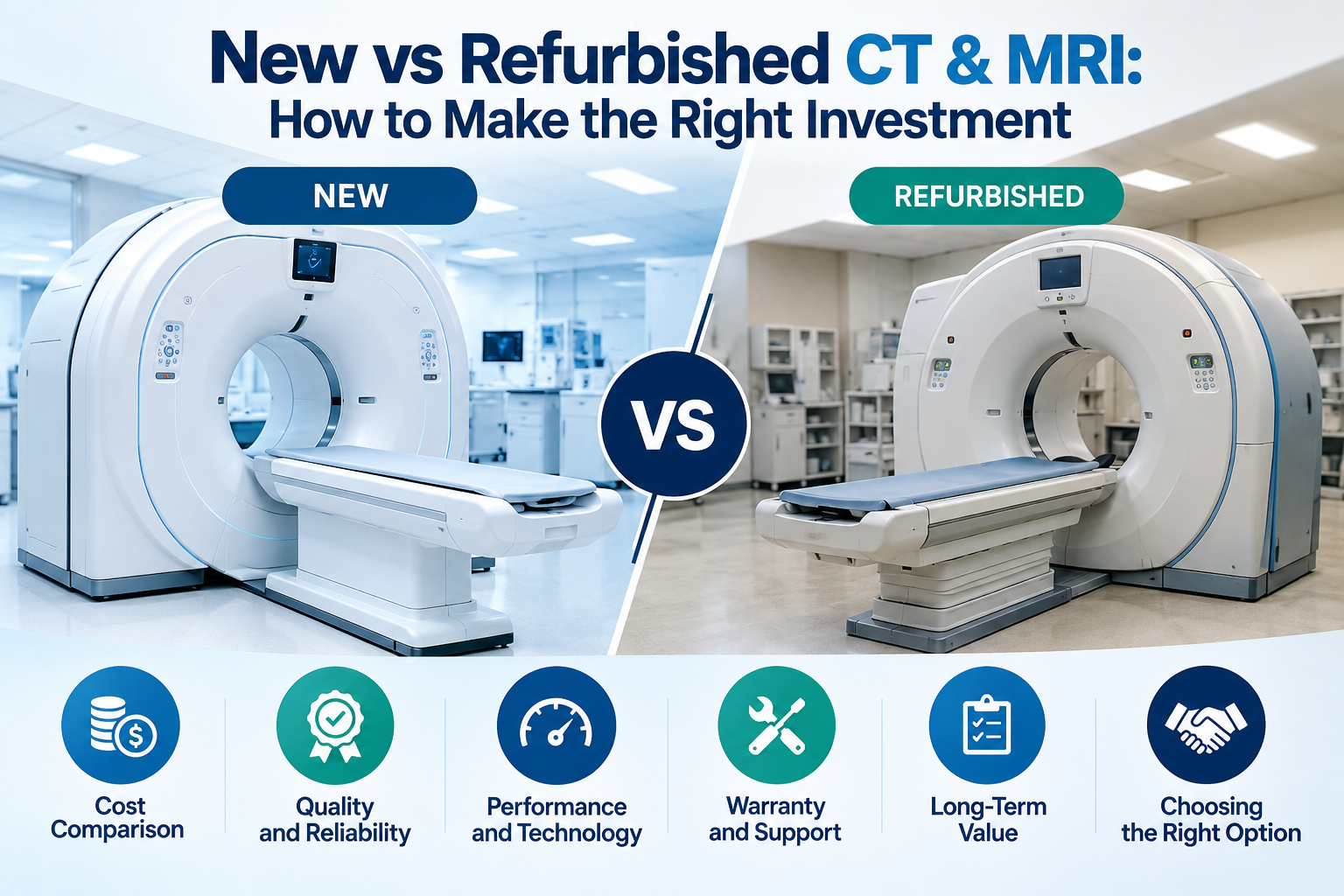
New vs Refurbished CT & MRI Scanners: How to Make the Right Investment
Choosing between new and refurbished CT and MRI scanners is a significant investment decision for hospitals, diagnostic centres and healthcare providers. The right choice affects not only capital expenditure but also diagnostic capabilities, operating costs, equipment uptime and long-term service requirements.
New imaging systems can offer access to newer technology, updated software and manufacturer-backed support. Refurbished systems, when properly evaluated and supported, can provide a more cost-effective way to establish or expand imaging services.
Neither option is automatically the better investment. The right decision depends on your clinical requirements, patient volumes, available budget, infrastructure, expected equipment life and access to technical support.
In this guide, we compare new and refurbished CT and MRI equipment across six important considerations to help you identify the option that best fits your healthcare facility.
Understanding New and Refurbished CT & MRI Equipment
New CT and MRI systems are supplied as new equipment, typically through manufacturers or authorised distribution channels. Depending on the agreement, the purchase may include installation, commissioning, operator training, warranty coverage and ongoing technical support.
Refurbished CT and MRI systems are pre-owned machines that have undergone varying levels of inspection, repair, component replacement, servicing and performance testing. The scope of refurbishment depends on the system and the supplier.
It is important to distinguish properly refurbished equipment from used equipment sold with little or no documented restoration. The term refurbished alone does not guarantee a particular level of quality, performance or remaining service life.
Before comparing prices, establish the actual condition of each system, the work completed, the configuration offered and the support available after installation.
1. Initial Investment and Total Cost of Ownership
Cost is often the first consideration when comparing new and refurbished imaging equipment. However, the purchase price should not be the only basis for the decision.
New CT and MRI scanners generally involve a higher initial investment. The quotation may include selected software options, installation, training and warranty coverage, but buyers should confirm exactly what is included.
Refurbished systems can offer a lower entry cost, potentially making imaging services accessible to smaller hospitals, independent diagnostic centres and facilities expanding their existing capacity.
However, a lower acquisition price does not automatically mean a lower overall cost. Buyers should account for:
Equipment price, transportation and insurance.
Installation, commissioning and acceptance testing.
Room preparation and infrastructure upgrades.
Electrical supply, cooling and other site requirements.
Software licences, clinical options and accessories.
Preventive maintenance, spare parts and repairs.
Potential downtime and the associated impact on operations.
For MRI systems, site preparation can be particularly important because of magnetic-field safety requirements and model-specific infrastructure. CT installations also require appropriate electrical, cooling and radiation protection arrangements.
The more useful comparison is the total cost of ownership over the intended operating period, taking account of both expenditure and expected operational performance.
A refurbished system may represent better value when its purchase price, condition, remaining useful life and support arrangements align with the facility's needs.
2. Technology and Clinical Capabilities
The technology available in a scanner influences the examinations it can support, workflow efficiency and suitability for particular clinical applications.
New CT systems may offer newer detector designs, advanced image reconstruction, dose-management features, faster scanning and updated clinical software. New MRI systems may provide newer imaging applications, workflow improvements and advances in system design, depending on the model.
Refurbished systems can still deliver valuable diagnostic capabilities. A carefully selected model may meet the requirements of a facility performing routine neurological, chest, abdominal, musculoskeletal or other examinations supported by that system.
The important question is not simply whether a scanner is new or refurbished, but whether its capabilities meet your current and anticipated clinical requirements.
Before making a decision, evaluate:
The range of examinations and clinical applications required.
Scanner configuration, software options and available protocols.
Image quality and relevant performance test results.
Scan speed, patient throughput and workflow requirements.
Compatibility with PACS, RIS and other hospital systems.
Availability of required coils, accessories and future upgrades.
For MRI, the field strength alone does not determine the suitability of a system. Configuration, coils, software and the intended clinical applications also matter.
For CT, detector configuration, reconstruction capabilities, scan protocols and dose-management features should be assessed against the facility's requirements.
Choose the technology that supports the examinations you need to perform—not simply the newest model or the lowest-priced system.
3. Reliability, Maintenance and Expected Service Life
Equipment reliability affects patient scheduling, staff productivity and the continuity of diagnostic services. Unexpected downtime can delay examinations, disrupt workflows and result in lost revenue.
New systems may offer warranty coverage and access to manufacturer support, but the actual service arrangements, response times and duration of support should be confirmed before purchase.
For refurbished systems, the equipment's maintenance history and current technical condition are especially important. Buyers should request available service records, details of previous repairs, refurbishment documentation and performance test reports.
For a refurbished CT scanner, pay particular attention to the condition and usage history of the X-ray tube, detector system, gantry and other major components. Ask about replacement tube availability and costs.
For a refurbished MRI system, assess the magnet, gradient and radiofrequency systems, available coils, cooling requirements and the availability of compatible spare parts. Establish whether the system's configuration can be supported over the period you intend to operate it.
In both cases, consider the supplier's ability to provide preventive maintenance, troubleshooting, component-level repairs and emergency support.
An independent technical inspection can help establish the system's condition before purchase. It should complement, rather than replace, the supplier's documented testing and contractual commitments.
The key consideration is not just how old the equipment is, but how well its condition, serviceability and expected operating life match your plans.
4. Warranty, Installation and After-Sales Support
A scanner's value depends partly on the support available after delivery. Installation quality, access to spare parts, qualified service engineers and timely repairs can all influence the long-term ownership experience.
New equipment purchases may include manufacturer-backed installation, commissioning, training and warranty support. However, the scope and duration of these services vary by supplier and contract.
Refurbished equipment suppliers may also provide installation, warranty coverage and maintenance packages. Buyers should evaluate these services carefully rather than assuming that all refurbished systems have limited support—or that every new system includes comprehensive coverage.
Before purchasing either option, clarify:
Warranty duration, component coverage and exclusions.
Responsibility for installation and commissioning.
Availability of qualified service engineers.
Expected response times for breakdowns.
Availability and cost of critical spare parts.
Preventive maintenance arrangements.
Operator training and technical documentation.
Support availability after the warranty expires.
For older systems, check whether the original manufacturer continues to support the model and whether essential components and software remain available.
The supplier's technical capabilities can be just as important as the equipment's purchase price. A practical service arrangement helps reduce the risk of prolonged downtime and unexpected maintenance expenditure.
5. Regulatory Compliance and Patient Safety
Both new and refurbished imaging equipment must meet the regulatory, safety and operational requirements applicable to the equipment and its intended location.
Before purchasing, verify the system's identification records, technical documentation, safety and performance test reports, installation requirements and eligibility for the intended use.
For CT scanners in India, buyers should establish the applicable radiation safety, quality assurance and approval requirements, including those involving the Atomic Energy Regulatory Board (AERB), where relevant.
MRI installations require appropriate magnetic-field safety arrangements, suitable site preparation and procedures for the safe operation of the system and its supporting infrastructure.
If the equipment is being imported, confirm the applicable import permissions and other regulatory requirements before committing to the transaction. Previous operation in another country does not automatically establish eligibility for import or use in India.
Involve qualified technical personnel and the facility's relevant safety personnel in the evaluation. Confirm who will be responsible for obtaining approvals and completing the required checks before clinical use.
Regulatory compliance should be treated as a fundamental requirement—not a factor to trade off against a lower purchase price.
6. Which Option Is Right for Your Healthcare Facility?
The decision ultimately depends on the facility's clinical objectives, financial position, expected patient volume and ability to support the equipment over its operating life.
When new CT or MRI equipment may be the better choice
Consider new equipment when:
Your clinical requirements call for specific newer technologies or applications.
You expect substantial patient volumes and require a suitable throughput and service plan.
Your budget supports the initial investment and associated infrastructure costs.
You want access to current manufacturer offerings and the support available under the purchase agreement.
The planned operating life and upgrade strategy justify the additional investment.
New equipment can be particularly attractive when the selected technology provides a clear operational or clinical advantage for the examinations your facility performs.
When refurbished CT or MRI equipment may be the better choice
Consider refurbished equipment when:
Managing initial capital expenditure is a priority.
The selected model meets your clinical and workflow requirements.
The equipment has documented service history and refurbishment records.
Its condition and expected useful life suit your investment horizon.
Spare parts, technical support and maintenance arrangements are practical.
The total cost of ownership compares favourably with available new alternatives.
Refurbished systems can be worth considering for facilities establishing imaging services, expanding capacity or seeking a cost-effective solution for defined clinical requirements.
Compare the investment, not just the equipment
Before deciding, evaluate the proposed systems against the same set of criteria: clinical suitability, total acquisition cost, infrastructure, expected service life, warranty, maintenance, parts availability and operational risk.
A lower-priced system may not be the best value if it requires substantial additional investment or cannot be supported reliably. Equally, a more expensive new system may not be necessary if a suitable refurbished model meets the facility's needs.
The strongest investment decision is the one that balances clinical capability, financial sustainability and dependable operation.
Conclusion: Make the Right Imaging Investment for Your Needs
Choosing between new and refurbished CT and MRI scanners is not simply a choice between the latest technology and a lower purchase price. It is a decision about clinical capability, capital allocation, equipment condition, serviceability and long-term operational value.
New systems may be the right choice when specific technological capabilities and the available manufacturer support justify the investment. Properly evaluated refurbished systems can offer an alternative for healthcare providers seeking to expand imaging capacity while managing capital expenditure.
Whichever option you choose, assess the equipment's configuration, performance, maintenance requirements, installation needs, regulatory status and support arrangements before committing to a purchase.
At Cyrix Healthcare, AURUM offers a route to explore refurbished medical imaging equipment, while ANKE provides new CT and MRI solutions. Cyrix's broader technical service capabilities can also support equipment maintenance, repairs and lifecycle management, subject to the system and service requirements.
Exploring CT or MRI Options for Your Facility?
Whether you are evaluating a new CT scanner, a refurbished MRI system or alternatives for expanding your imaging services, our team can help you explore the available options.
 +91 9072522062