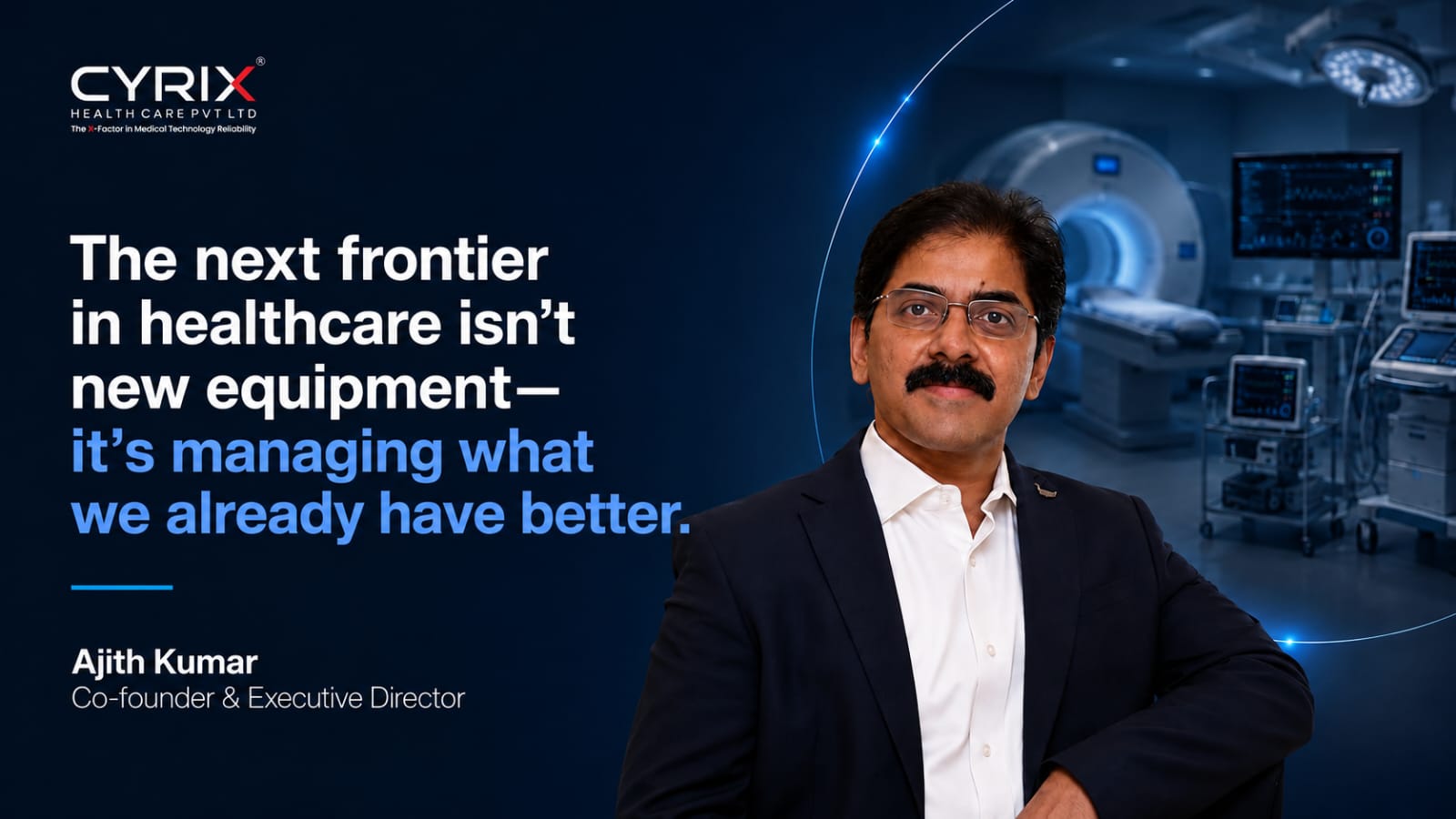
The Next Frontier in Healthcare Isn't New Equipment. It's Managing What We Already Have Better.
Every hospital today is investing in advanced medical technology. MRI systems, CT scanners, ventilators, operating theatres, laboratory automation, patient monitoring systems—the list continues to grow.
These technologies have transformed patient care. Yet one question continues to concern hospital leaders everywhere:
Are we managing these valuable assets as effectively as we should?
For many hospitals, medical equipment management has evolved over time rather than by design. Different manufacturers, multiple service providers, varying maintenance contracts, manual records, separate calibration schedules and disconnected reporting often become part of daily operations. While each system may work independently, together they create unnecessary complexity.
The result is familiar.
Equipment downtime affects patient care.
Maintenance costs become difficult to predict.
Biomedical teams spend valuable time coordinating multiple vendors.
Hospital leadership often lacks a single view of equipment performance, lifecycle costs and operational reliability.
The challenge is no longer maintaining individual machines.
The challenge is managing the entire medical technology ecosystem—ensuring every device, regardless of brand or manufacturer, performs reliably throughout its lifecycle while supporting better patient care.
As hospitals become increasingly dependent on technology, medical equipment management can no longer remain a maintenance function alone. It is becoming a strategic operational discipline that directly influences clinical outcomes, financial performance and patient experience.
This is why I believe it is time for healthcare to embrace a Total MedTech Management approach—one that focuses on managing the complete lifecycle of medical technology rather than isolated maintenance activities.
It begins by asking better questions.
Are our critical assets delivering the uptime they should?
Are we extending equipment life wherever possible?
Are we balancing quality, compliance and cost effectively?
Are we making informed decisions based on data rather than assumptions?
Are we simplifying the complexity of managing multiple equipment brands and service providers?
Do hospital leaders have the visibility they need to make strategic decisions?
These questions are becoming increasingly important as hospitals expand their technology footprint while managing tighter budgets, rising patient expectations and growing regulatory requirements.
At Cyrix Healthcare, these questions have shaped the way we work with hospitals for more than two decades. They have inspired us to build the Total MedTech Management Ecosystem—an integrated approach that brings together every capability required to maximise equipment uptime and manage the complete lifecycle of medical technology.
At the heart of this ecosystem is Care360, our Total Hospital Equipment Care Programme, providing 360-degree management of medical equipment—any brand, any device, throughout its entire lifecycle. Supporting Care360 are specialised capabilities including ReviveLab for advanced repairs, AURUM for renewed medical systems, CIYAN for consumables and compatible accessories, ExpertLink for remote technical expertise, and the Cyrix Academy for skill development.
Together, they form one ecosystem with one purpose—to help hospitals maximise the value, reliability and lifespan of their medical technology.
Today, we are beginning a conversation around this approach.
Over the coming weeks, we will be sharing ideas, experiences, customer stories, industry perspectives and practical insights on how hospitals can improve equipment reliability, simplify equipment management and maximise the return on their technology investments.
Healthcare technology is one of a hospital's greatest investments.
The question is no longer whether hospitals should invest in technology.
The question is how effectively they manage that investment throughout its lifecycle.
I look forward to hearing your thoughts and learning from your experiences as we work together towards a more reliable, efficient and sustainable future for healthcare technology.
 +91 9072522062