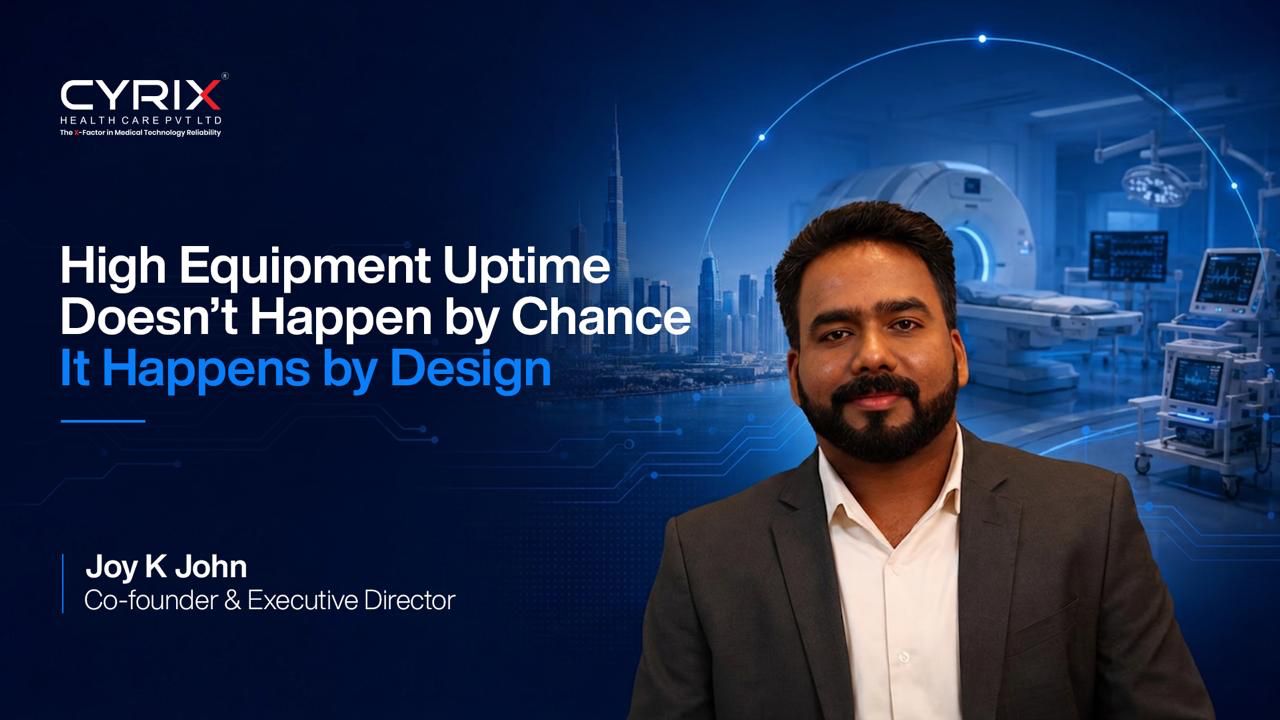
High Equipment Uptime Doesn't Happen by Chance. It Happens by Design.
High Equipment Uptime Doesn't Happen by Chance. It Happens by Design.
Every hospital wants reliable medical equipment.
Every biomedical engineer wants fewer breakdowns.
Every hospital administrator wants predictable maintenance costs.
And every clinician wants equipment to be available when patients need it.
After working closely with hospitals across India for many years, I've realised that everyone is working towards the same objective—maximum equipment uptime. Yet achieving it has become increasingly challenging.
Hospitals today manage equipment from multiple manufacturers, coordinate different service providers, maintain preventive maintenance schedules, ensure calibration compliance and respond to unexpected breakdowns—all while balancing operational and financial pressures.
In my experience, equipment downtime is rarely caused by one major issue.
More often, it results from several small gaps—missed preventive maintenance, delayed repairs, limited visibility, fragmented vendor management or ageing equipment.
As hospitals become more technology-intensive, equipment management is no longer just about repairing machines. It is about ensuring every critical device performs reliably throughout its lifecycle.
That is why I believe hospitals need to move beyond isolated maintenance activities and adopt a more integrated approach to managing medical technology.
This thinking is at the heart of Total MedTech Management—an approach that focuses on equipment reliability, lifecycle performance and operational efficiency.
Over the coming weeks, I'll be sharing practical experiences from the field, common challenges hospitals face and ideas that have helped improve equipment reliability and simplify equipment management.
I'd also love to hear your perspective.
What is the biggest challenge your hospital faces in managing medical equipment?
What practices have made the biggest difference in improving equipment uptime?
 +91 9072522062